
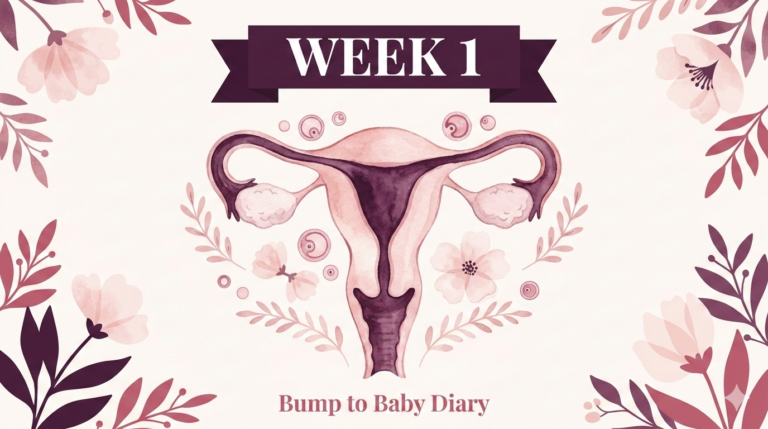
Week 1 of Pregnancy: Symptoms, Body Changes & What to Expect
You're not technically pregnant yet — and that's completely normal. Here's everything happening in your body right now.
1Is Week 1 of Pregnancy Really a Pregnancy?
The short answer: medically, yes — even though there's no baby yet. This confuses nearly everyone, so let's clear it up once and for all.
Gestational Age vs. Fetal Age
There are two ways to measure a pregnancy:
When your doctor says you're "12 weeks pregnant," your baby has technically only existed for about 10 weeks. Both are correct — they're just measuring different things.
Why Do Doctors Start Counting From Your Period?
Because pinpointing the exact day of conception is nearly impossible — even with modern tracking tools. Sperm can survive in the reproductive tract for up to 5 days. An egg lives for just 12–24 hours after ovulation. The day you had sex is often not the day fertilization occurred.
The first day of your period, however, is an unmistakable, objective biological event that every woman can observe and remember. It became the universal standard — and that's why your pregnancy technically "starts" before you've even conceived.
2What's Happening in Your Body at Week 1
Think of Week 1 as your body doing a complete biological reset — clearing out the old, and preparing optimal conditions for new life.
The Hormonal Shift
At the start of Week 1, estrogen and progesterone are at their absolute lowest. This sharp hormone drop is the trigger that causes your uterus to shed its lining (the endometrium) — which is what menstruation is.
As bleeding slows toward the end of the week, your brain releases Gonadotropin-Releasing Hormone (GnRH), which triggers the pituitary gland to produce Follicle-Stimulating Hormone (FSH). FSH tells your ovaries to start growing a new batch of follicles. As these develop, they produce estrogen — which starts building a fresh, nutrient-rich uterine lining ready to receive a fertilized egg.
The Ovarian "Casting Call"
FSH stimulates 15–20 follicles to begin maturing simultaneously. Each contains one immature egg (an oocyte). Here's a remarkable fact: the egg that may become your baby has been inside your body since you were a fetus in your own mother's womb.
Over the coming days, one follicle will outgrow the rest — the dominant follicle. The others break down and are reabsorbed. This dominant follicle will release its egg during ovulation, typically around Week 2–3.
3Week 1 Pregnancy Symptoms
Since Week 1 coincides with your period, what you experience are classic menstrual symptoms — not pregnancy symptoms:
These are not pregnancy symptoms. True early pregnancy symptoms (like nausea, heightened smell, or implantation spotting) typically don't appear until gestational Weeks 4–6, after the embryo has implanted and hCG levels rise.
4What's Happening with the Baby (The Blueprint Stage)
There is no embryo to track this week. However, the biological foundations for your future baby are actively being prepared — which is why we call this the Blueprint Stage. The genetic material that will form 50% of your future child's DNA is undergoing its final maturation inside the dominant follicle.
Pregnancy Development Timeline
| Week | Key Development |
|---|---|
| Week 1 | Follicles begin maturing; uterine lining sheds and rebuilds |
| Week 2 | Dominant follicle matures; LH surge triggers ovulation |
| Week 3 | Ovulation occurs; sperm meets egg; fertilization happens |
| Week 4 | Fertilized egg implants in uterine lining; hCG hormone is released — pregnancy test may turn positive |
5How Your Due Date Is Calculated: Naegele's Rule
The standard method for calculating your estimated due date (EDD) is called Naegele's Rule, developed by German obstetrician Franz Karl Naegele in the early 1800s and still used worldwide today.
📐 Naegele's Rule Formula
Naegele's Rule assumes a perfect 28-day cycle with ovulation on Day 14. In reality, healthy cycles range from 21–35 days. Only about 4–5% of babies are born on their exact due date. Your EDD is a target window, not a hard deadline.
Sarah, 29, just got a positive pregnancy test. Her doctor asked for her LMP: October 1st. Her app says she's "4 weeks pregnant." But she knows she conceived around October 15th.
How can she be 4 weeks pregnant if the baby is only 2 weeks old?
6Week 1 Pregnancy Checklist
Even though conception hasn't happened yet, these steps can meaningfully impact your baby's development in the critical early weeks ahead:
-
💊Start a Prenatal Vitamin Today Don't wait for a positive test. Begin a daily prenatal vitamin with at least 400 mcg folic acid + iron, calcium, and vitamin D. Look for USP or NSF certification on the label for quality assurance.
-
📅Track Your Cycle Precisely Note today's date as Day 1. Start tracking basal body temperature (BBT) each morning or use OTC ovulation predictor kits (OPKs) to identify your fertile window (typically end of Week 2 / start of Week 3).
-
🚭Audit Your Lifestyle & Medications Eliminate alcohol, tobacco, and recreational drugs. Review all prescription and OTC medications with your doctor — ibuprofen and certain acne treatments may not be safe. Limit caffeine to under 200 mg/day.
-
🩺Schedule a Preconception Appointment Book a visit with your OB-GYN or midwife to review your medical history, discuss genetic screenings, and get baseline bloodwork done before you conceive.
7US Health Insurance & Preconception Tips
Folic Acid: The CDC Recommendation
The CDC recommends 400 mcg of folic acid daily starting at least one month before trying to conceive. Folic acid significantly reduces the risk of Neural Tube Defects (NTDs) like spina bifida. The neural tube forms within the first 28 days of fetal age — often before you even know you're pregnant.
The FDA regulates supplements less strictly than medications. Look for a USP or NSF International seal on the label — this indicates third-party testing that confirms the product actually contains what it claims.
Insurance Audit Checklist
Requires a referral from your primary care physician to see an OB-GYN. Must stay in-network. Lower premiums, but less flexibility.
More flexibility to choose an OB-GYN or midwife without a referral. Out-of-network care is allowed but costs more.
Check your Out-of-Pocket Maximum. Pregnancy often means hitting this number. Understanding it now helps you budget for the year ahead.
Federal law (2022) protecting you from unexpected out-of-network bills for emergency care and certain services at in-network facilities.